| |
|
|
|
|
| |
The Protest |
|
|
|
| |
|
|
|
|
| |
Big Trees Destroyed |
|
The Treesit |
|
| |
The Parking Lot |
|
FROG "Ribbits" |
|
| |
Friends of Cathedral Grove (FROG) |
|
Habitat Encroachment |
|
| |
|
|
|
|
| |
|
|
| |
|
|
|
|
| |
Big Trees Destroyed
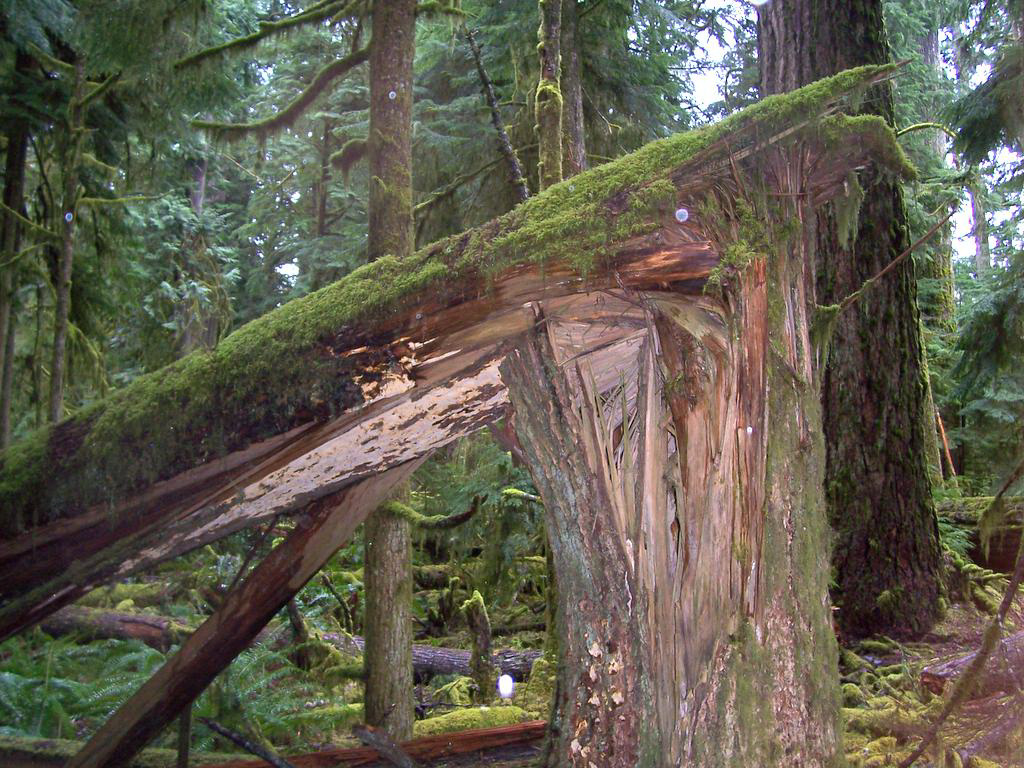
The American forest annihilation company Weyerhaeuser bought out its Canadian counterpart MacMillan Bloedel in 1999, thereby becoming the biggest holder of private and public forest lands in British Columbia (BC). In 2000, Weyerhaeuser destroyed countless big trees in the critical buffer zone that protects the vulnerable big trees in Cathedral Grove from storm winds and blowdown. Annette Tanner of the Western Canada Wilderness Committee was shocked to discover that healthy Douglas firs many hundred years in age had been brutally massacred (right). Compelling arguments abound for protecting what little remains of the world's ancient temperate rainforests, yet the big trees which are the hallmarks of BC have no protective legislation and continue to be exterminated with impunity. |
|

Weyerhaeuser stump, Cathedral Grove
Photo: Ron Smid |
|
| |
|
|
 |
|
| |

"Ancient trees cut," 8 March 2000
Photo: Ray Smith |
|
To gain access to the profitable big trees, Weyerhaeuser blasted a new logging road two km long and 40 m wide into the ancient forest habitat next to Cathedral Grove: Stop Weyerhaeuser. The result was the annihilation of about 5000 cubic m of the endangered ancient Douglas fir ecosystem, the equivalent of over 100 truckloads of commercial old growth logs. A shocking photo of the desecration was featured on the front page of the Times Colonist newspaper with the headline: "Ancient trees cut near Catheral Grove" (left).
After surveying the devastation in March 2000, Annette Tanner reported to the press: "It's a sea of old growth chopped down as far as the eye can see." She noted that such blatant acts of nature destruction result from the "disrespect of this generous legacy from our ancestors and creator." In Europe such acts would be illegal: in BC, it is merely another instance of industrial profit taking by a corporation that has no conscience. |
|
| |
|
|
|
|
| |

"Clearance at Cathedral Grove," 4 August 2001
Photo: Times Colonist
The clearcutting of the Cathedral Grove Watershed and the destruction of much of the old growth buffer zone made it possible that the record "Qualicum" storm on New Years Day 1997 caused massive windthrow damage. Trees two meters in diameter snapped like matchsticks (right). Today windthrow is the most significant threat facing the park yet cutblocks by unscrupulous logging companies continue. |
|
Industrial clearcuts are massive graveyards of cumulative biodiversity and while these clearcuts litter the wilderness landscape of BC in out of sight places, far away from population centers, such scenes of destruction can now also be seen at Cathedral Grove, a much loved and heavily visited public park. A critical letter to the Victoria newspaper in 2001 was illustrated by a photo of the "clearance" by Weyerhaeuser (left).

Giant tree snapped by wind.
Photo: Rodeocatz (Click to enlarge) |
|
| |
|
|
|
|
| |

Culturally modified tree, Cathedral Grove, 2007
Photo: Karen Wonders |
|

Bark stripped tree, Cathedral Grove, 2007
Photo: Karen Wonders
Along with the industrial clearcutting of the commercially lucrative Douglas fir giants in the Cathedral Grove Watershed, the destruction of many "culturally modified trees" (CMTs) has taken place without regard for their value as aboriginal heritage. Today the unprotected Douglas fir forest adjacent to the tiny protected park area contains hundreds of remarkable CMTs including bark stripped cedars (above and left). Some of these archaeological artifacts have strip "catfaces" more than 100 feet long, and each tree has been peeled on its uphill side. The CMTs survived a massive fire in 1885 and are some of the tallest to inhabit this endangered "Heritage Forest." |
|
| |
|
|
|
|
| |
 |
 |
|
James Fletcher (1852-1908) |
Primaeval Douglas fir forest scene at Cathedral Grove |
|
|
| |
|
|
|
|
| |
James Fletcher was an English born Canadian entomologist and botanist (above). A fellow of the Linnean Society of London, he was elected to the Royal Society of Canada in 1885. Based in Ottawa, Fletcher travelled to BC in 1901 to lecture. During his trip he climbed Mt Arrowsmith and explored the "virgin" Cameron Lake forest. He was amazed at the gigantic Douglas firs, a species first "discovered" on Vancouver Island in 1791. Cones from the species (right) were avidly collected by eminent European botanists.
Officially Fletcher's task was to inform farmers in the Alberni Valley on how to use gun powder to blow up the giant stumps that impeded the conversion of the forests to agricultural land. Back in Ottawa he addressed the second meeting of the Canadian Forestry Association, pleading members to preserve Cathedral Grove: "I urge you to do everything in your power to preserve the magnificent forest around Cameron Lake, within a few miles of Alberni. I believe this is one of the finest pieces of standing timber in the world. The very size of the trees [as up to the present there are no railways there] would protect it for many years. . . there are few places where trees of from five to eight feet in diameter could be seen, as is the case there, by thousands. . . everyone should do something to create an interest in this subject" Report of Entomologist and Botanist James Fletcher (Sessional Paper No. 16, 1901). |
|

Douglas fir cone
Photo: Walter Siegmund |
|
| |
|
|
|
|
| |
 |
Left:
A Chronology of Cathedral Grove
"The road for about seventy miles is almost straight and through a virgin forest of Douglas fir . . . The trees are from 200 to 300 feet in height, straight as a lance and most symmetrical in shape, with no branches for the first 100 or 150 feet. The tops are like a huge plume of very dark green foliag . . . So graceful, so perfectly symmetrical are they that it is difficult to realize their great size . . . The road winds about the shore of the lake and in and about a grove of magnificent fir trees. "
"The trees are from 35 feet in height and have all the symmetry and beauty of the smaller firs and the grandeur of their gigantic size . . . We are all silent, awed by this most impressive spectacle . . . these trees are from 600 to 700 years old, and I feel their beauty and majesty as I did that of old St. Paul's — God made them"
Edward T. Buxton, 1907 |
|
|
| |
|
|
|
|
| |
Fletcher's 1901 plea to the Canadian Forestry Association to protect Cathedral Grove fell on deaf ears, because, like its American counterpart, the group was essentially a lobbying arm of the forest industry. Almost 20 years later another effort was made to gain the support of the Association, this time by James Robert Anderson (right), a colleague of Fletcher's and vice president of the Natural History Society of BC. In 1919 he travelled to Ottawa to urge that the ancient giant firs at Cameron Lake be saved from the logging industry and instead be preserved as national heritage, dedicated to the memory of soldiers killed in WWI:
"Monuments erected by the hand of man fade into insignificance when compared to this natural monument erected by the hand of God . . . to those members of the Canadian Forestry Association who have not visited the West. . . they have yet to see a forest in all its magnificence, and no other word seems to me to convey a proper idea of a virgin forest of the west. Picture to yourself thousands of trees, Douglas fir predominating, of prodigious size, so close together that it is with diffficulty through which the rays of the sun scarcely penetrate, the ground carpeted with mosses and ferns, and the hush of nature all around you, and you can, perhaps form some idea of this forest in BC" Port Alberni News (24 December 1919). |
|

James Robert Anderson, n.d.
Photo: British Columbia Archives
|
|
| |
|
|
|
|
| |

Mt Arrowsmith, Cameron Lake, 1912
Photo: British Columbia Archives
The name "Cathedral Grove" is said to have originated in a remark by the Governor General of Canada, Frederick Freeman Thomas (Viscount Willingdon), in April 1928. Although the big trees were a popular attraction, they belonged to the "Block 35" forestlands owned by the Victoria Lumbering and Manufacturing Company. Part of the 1886 Dunsmuir land grab; the Cameron Lake Watershed was sold in 1889 to the American owner of Victoria Lumbering, John A. Humbird, who made a fortune selling Vancouver Island's primaeval Douglas firs to lumber markets around the world. Thus while the remarkable big trees of Cathedral Grove were increasingly admired by the public, similar trees at Cameron Lake, up to 1,000 years old, were being ruthlessly felled by high riggers for commercial products (right). |
|
The opening up of the Cameron Lake Valley and Alberni Valley by the E&N Railway in 1911 gave the logging industry access to the "big timber" and spurred the demise of the forests. Frank Swannell photographed the Arrowsmith Massif looming over the fir forests at Cameron Lake in 1912 when the train station here was still being promoted as a popular tourist destination (left).

High rigger, Cameron Lake, c. 1920
Photo: British Columbia Archives |
|
| |
|
|
|
|
| |
The BC Forest Service was founded in 1912, with logging baron H. R. MacMillan its first chief. Rather than uphold the public's interest by protecting and managing the Crown (public owned) forestlands, the government agency served the timber industry, beginning with MacMillan. Typical was a 1931 Forest Service photo taken at Cameron Lake (right), used as an example of a "pure stand" of Douglas fir forest, stressing its lucrative commercial value as lumber. Neither the Canadian Forestry Association (founded in 1900) nor the BC Forestry Association (1925) made any effort to act on repeated requests by citizens to save Cathedral Grove.

Ancient Douglas fir, Cameron Lake, 1931
Photo: British Columbia Forest Service |
|

"Douglas fir forest," Cameron Lake, 1931
Photo: British Columbia Forest Service
A second BC Forest Service photo, also taken in 1931 at Cathedral Grove (left), shows a big tree with the caption "Douglas fir with 122'' D.B.H [diameter at breast height] near Cameron Lake." Many similar photos demonstrate the purpose of the BC Forest Service to liquidate the old growth forests. No attempt was made by the government agency to save the rapidly vanishing big trees from the rapacious timber industry. Instead that initiative was left to community members and those involved with early tourism ventures. Thus in 1929 the Associated Boards of Trade of Vancouver Island petitioned the BC government to preserve Cathedral Grove for public benefit. |
|
| |
|
|
|
|
| |
The tallest, largest, and oldest trees in Canada grow on the West Coast of Vancouver Island. These are ancient organisms in a temperate rainforest that has a greater biomass than any other ecosystem on Earth. Yet within the short period of colonialization, industrial logging has destroyed 85 of the original 91 watersheds on the Island and less than 9% of the intact forest remains today.
Frank J. D. Barnjum made a fortune in the lumber industry long before he wrote the treatise "Saving the Big Timber" in 1930. Called "Canada's Forest Conservation Crusader," he is seen in a BC Forest Service photo beside a Douglas fir in 1931 (right). In 1932 Barnjum purchased 2,000 acres of one of the last remaining stands of "virgin" timber on Vancouver Island in order to preserve the big trees which he warned were rapidly approaching extinction. The following year he died unexpectedly and Barnjum's ancient grove in Cowichan Valley was later destroyed by the logging industry.

Cutblocks at Cameron Lake, 1982 (Click to enlarge)
British Columbia Parks |
|

Frank J. D. Barnjum, 1931
Photo: British Columbia Forest Service
Unlike Barnjum, H. R. MacMillan never recanted on his lifelong mission to become the "Emperor of Wood," as he liked to be known. A former timber cruiser who became BC's first "Chief Forester," he knew the commercial value of Vancouver Island's exceptional intact temperate rainforests and quickly staked his claim on these by leasing "Timber Berths" and grabbing the logging rights to large numbers of entire watersheds. Parks were the last thing that MacMillan wanted to interfer with his profits. A 1992 "land status" map shows how the area around Cameron Lake is sectioned into Crown and private cutblocks "Bks" (left). The two small parks were added in the early 1940s only after massive logging in the Cathedral Grove Watershed had already taken place. |
|
| |
|
|
|
|
| |

Alberni Road around Cameron Lake, 1937
Photo: British Columbia Archives |
|

Alberni Road around Cameron Lake
Photo: British Columbia Archives |
|
| |
|
|
|
|
| |
Instead of developing the E&N Railway as the primary transport system into Port Alberni for both passangers and freight, the government chose to widen the Alberni Road. Thus Angel Rock (above), the landmark geological formation on Cameron Lake was destroyed in 1940 in order to facilitate commercial trucks serving the pulp and paper industry. Cathedral Grove and Cameron Lake remained popular recreational destinations in the 1930s (below) even as the valley was being voraciously clearcut logged. Among the small contractors working in the cutblock was the Cameron Lake Logging Company (right).

"Mount Arrowsmith, BC," c. 1937
Photo: British Columbia Archives |
|

Cameron Lake Logging Co., c. 1937
Photo: British Columbia Archives
In 1936 the timber at Cathedral Grove was valued at $585,000. Alberni MLA Arnold Hanna warned: "No axe or saw has yet touched Cathedral Grove and I would like to tell the Minister of Lands that if this area of timber is not saved for posterity as a timber reserve, this government may as well close up." Also in the same year Lord Tweedsmuir, Governor General of Canada, pleaded: "Do not let the wonderful natural growth of Vancouver Island disappear through carelessness – see that you protect that growth for the future good of your island. You have a treasure house that is worth saving." But in 1939 preservation efforts were set aside when WWII began and the BC Forest Act was suspended to allow logging and lumbering to be classified as war industries. |
|
| |
|
|
|
|
| |

"Mixed Stand: Cathedral Grove," 1941
Photo: British Columbia Forest Service
During his long tenure as the owner of Canada's largest logging company, MacMillan showed no interest in protecting old growth forests. Cathedral Grove was calculated to contain c. 25,000,000 board feet of lumber and MacMillan rebutted any attempt to save the big trees until 1944 when he was pressured at a Port Alberni meeting: "After much haranguing, verbal battling, and shouting, H. R. stormed out of the hall, shouting 'All right! You can have the God – damned grove,' slamming the door as he left. This public victory resulted in provincial park protective status for 136 ha [330 acres] of old growth forest, including Cathedral Grove, in 1947"
Kerry Joy (BC Forest History Assoc. 2004). Objections to naming the park after the biggest profiteer of ancient forest destruction on Vancouver Island were ignored and official government ceremonies have ever since been to celebrate "MacMillan Provincial Park" (right). |
|
For years members of the public, represented by the Vancouver Island Tourist Association and the local chambers of commerce, petitioned the government to protect Cathedral Grove as a public park. The role of the BC Forest Service to promote silviculture and the growing of new forest crops is reflected in its 1941 photo of the Grove captioned "Mixed Stand" (left). In 1942 Port Alberni mayor Mike Hamilton wrote BC's Chief Forester: "Reports indicated you are opposed to preservation of Cathedral Grove. Be advised people here are very determined on its preservation." In 1944 a murky deal resulted in H. R. MacMillan taking over Victoria Lumber Company thereby consolidating his huge timber holdings on Vancouver Island and making him the new owner of Cathedral Grove.

MacMillan Provincial Park, 1953
Photo: British Columbia Archives |
|
| |
|
|
|
|
| |

Cameron Division logging road, c. 1970
Vancouver Island, British Columbia
|
|

"Opening of Cameron Division." 1965
Photo: University of British Columbia
To expand its global market, in 1951 H. R. MacMillan merged with another large timber holder on Vancouver Island, the American company Bloedel, Stewart and Welch, to form MacMillan Bloedel. A "MacBlo" PR photo (above) shows an ancient cedar log from Cameron Lake being loaded onto a truck to mark the opening of the Cameron Division in 1965. As MacBlo's 19th logging division, its purpose was to supply old growth logs to the Alberni Pulp and Paper Division and Alberni Plywood Division. Along with the adjacent Franklin Division (the world's largest logging operation) the Cameron Division laid waste to the intact primaeval forests (left). |
|
| |
|
|
|
|
| |
In his book "Giant Trees of Western America and the World" (2005), the international big tree expert Al Carder described an encounter he had in 1932 with H. R. Macmillan. "Raw exploitation" and schemes to advance his fortune was all that the timber baron was interested in: "how and where to obtain choice tracts of timber for logging." Carder expressed his profound sadness: "The magnificent southwest coastal forests of BC were given over to men of narrow outlook and self interest. . . for them the beauty of the natural world counts for virtually nil, as does the public good. The sole motivation is profit. . ."
Giant Douglas firs such as those at Cathedral Grove (right) are extraordinary biological creations that can live for 600 to 800 years, with extreme ages of 1500 years and older reached on drier upland sites. Carder writes of these natural monuments: "A towering, old–time Douglas–fir is one of the natural wonders of the world: the stupendous trunk is arrow-straight and fluted like some ancient column."

"Falling a large Douglas fir," c. 1945
Photo: British Columbia Forest Service |
|

Ancient Douglas fir, Cathedral Grove
Vancouver Island, British Columbia
While they were abundant the Douglas fir giants of BC provided the enormous profits of the timber economy. Between 1940 and 1948 the south coast region of BC, including Vancouver Island, supplied 55% of the total lumber production in Canada. Despite the scientific knowledge of forest ecology and management, no effort was made to make the logging industry sustainable. The BC Forest Service has consistently promoted and documented the demise of the primaeval Douglas fir forests (left). Shocking evidence of irrepairable degradation is glibly labeled as "primary forest conversion," corporate propaganda engineered to create the false impression that industrial tree plantations with 40 to 80 year crop rotations can somehow supplant the native intact forests. The failure of the tree farm plantation model is seen everywhere today in devastated watersheds. |
|
| |
|
|
|
|
| |

Clearcut hillside adjacent to Cathedral Grove
Photo: Richard Boyce
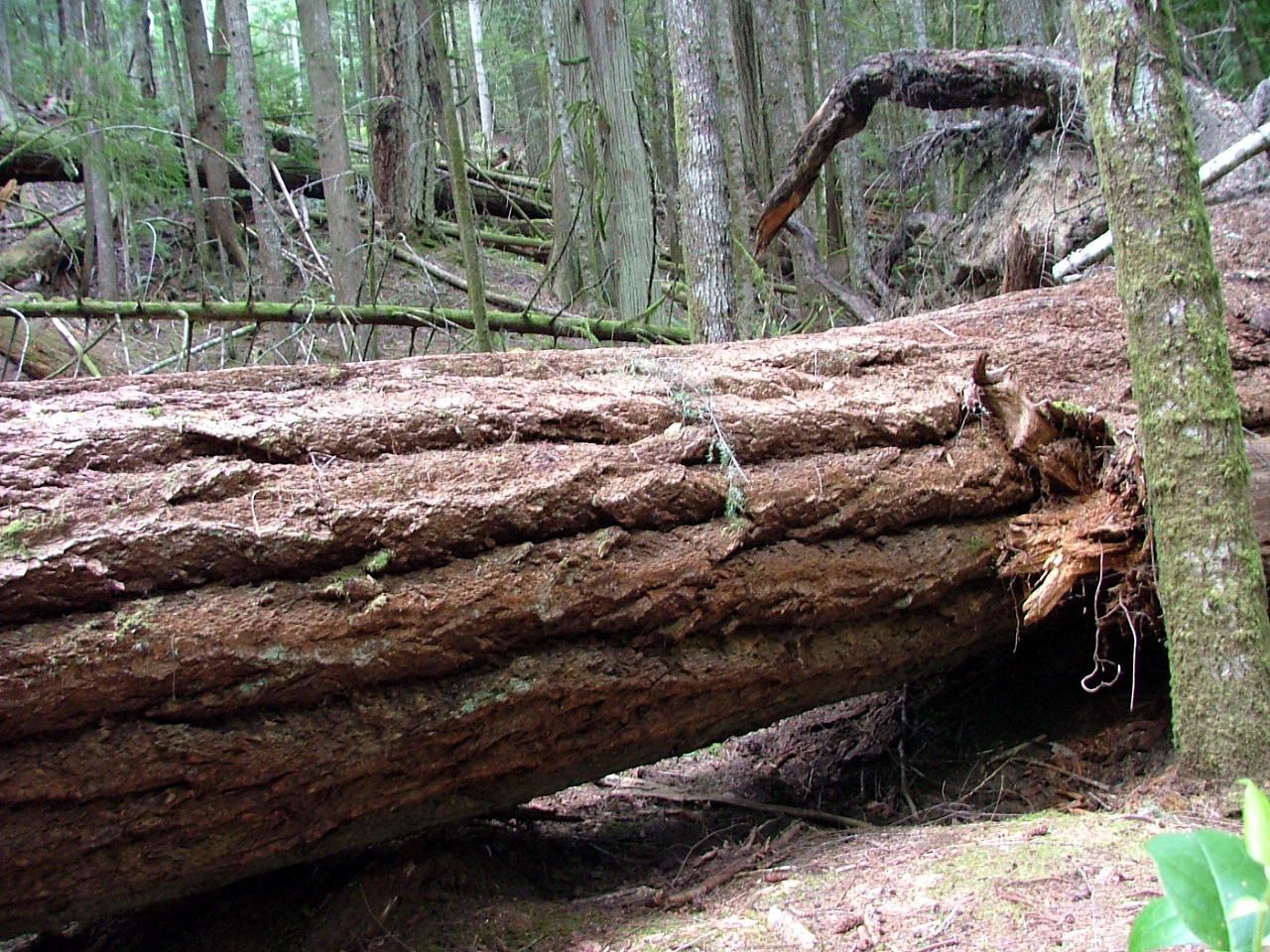
Without a forest buffer, the big trees in Cathedral Grove are precariously exposed to the winter storms which blow in from the Pacific Ocean. Many trees have collapsed and fallen, unable to withstand the powerful gales. A photo shows the size of one downed tree on the southern edge of the park; a person, circled in red, is walking along the stem (right). |
|
Cathedral Grove is surrounded by a sea of industrial cutblocks that stretches all the way to the Pacific Rim National Park. Even the forests on the high slopes above the big trees have been ravaged by clearcut logging with no concern over the long term ecological damage to the steep Cameron River valley (left).

Fallen giants on the edge of Cathedral Grove
Photo: Richard Boyce |
|
| |
|
|
|
|
| |
The downing of the big trees due to windfall had a tragic consequence during a storm on 29 December 2003 when two people were killed after a 60 – metre Douglas fir tree came crashing down on their car which was parked on the highway in Cathedral Grove (right). The tragedy resulted in the BC government reviving its original 1998 plan to build a two hectare parking lot expansion upstream from the big tree stand. This plan was rejected in 2001 and again in 2004 by environmentalists who argued that clearing more land would only cause more giants to be exposed to high winds and blowdown and woud exasperate the problem. Over the years the BC government has initiated various rehabilitation efforts for the endangered ancient Douglas fir stand located in the middle of a commercial timber cutblock. However none can succeed while logging companies continue their destruction of the Cathedral Grove Watershed. |
|
Car crashed by big tree, 2003
Cathedral Grove, Vancouver Island |
|
| |
|
|
|
|
| |

Douglas fir blowdown, Cathedral Grove, 2006
Photo: Ngado (Click to enlarge) |
|
After Weyerhaeuser bought MacMillan Bloedel in 1999 for $4 billion, the barbaric practice of killing ancient endangered big trees, including those survivors in a vital buffer area adjacent to Cathedral Grove, continued at an even faster rate. The predictable result was more blowdown of the rare Douglas fir giants in the tiny park (left).
Widespread public outrage at this corporate vandalism led in 2000 to a campaign to expand the boundaries of Cathedral Grove. The move was spearheaded by the Western Canada Wilderness Committee. The designation in 2000 of the Mount Arrowsmith Biosphere Reserve which includes Cathedral Grove has not curtailed the logging companies. In 2001 TimberWest logged the area of a pristine trail that begins at the Alberni Highway beside Cathedral Lake, just a few kilometers from Cathedral Grove. |
|
| |
|
|
|
|
| |
 Ancient trees marked for heli logging, October 2005
Photo: Phil Carson |
|
In October 2005 Friends of Cathedral Grove (FROG) discovered that Island Timberlands, a subdivision of Brookfield (aka Brascan) – the corporate successor to MacMillan Bloedel and Weyerhaeuser – was using helicopters to log the few remaining pockets of old growth forest in Cathedral Canyon. Targeted big trees were marked with pink tape and spray painted with blue numbers (left). These – until then inaccessible – big trees grow along the flood plain and steep slopes of Cameron River which flows downstream through Cathedral Grove. Such an irresponsible and destructive "guts and feathers" logging operation removes essential wind buffer in the valley, changes the hydrology, destroys fish habitat and impacts the supply of drinking water to nearby communities.
MacMillan Park Stumpfield In March 2005 the org "Nature Trust of BC" released a PR announcing a "ground breaking" agreement gag to conserve the "towering giants" of Cathedral Grove made possible by the generosity of an "eco gift" from Weyerhaeuser and the "60 year legacy" of the MacMillan family. Nature Trust of BC was founded in 1971 by the former chairman of the MacMillan Bloedel logging corp and provides corporate and government greenwashing. As a result of the Nature Trust deal Cathedral Grove was increased in size from 157 hectares to 280 hectares (690 acres). In fact the paltry $4.6 million "eco gift" much touted by Nature Trust consisted of a Weyerhaeuser logged stumpfield valued at $2.5 million and a MacMillan family donation of $290,000. Both were corporate tax writeoffs.
|
|
| |
|
|
|
|
| |
Corporate Carnage The international logging and wood products industry regularly rebrands itself and changes company names thereby erasing negative associations. As these demolition corporations destroy the last remnants of BC's intact forests and big trees, the rebranding process becomes evermore frantic, along with a gush of government press releases intended to cover up the deforestation designs of its crooked cronies (above). The corporate "forest flipping frenzy" has dire ecological consequences including the annihilation of Vancouver Island's ancient fir forests and the extermination of the Vancouver Island marmot. Ingmar Lee:
Logging Lackies.
During its two year forest blockade that ended on 22 June 2005, the Friends of Cathedral Grove (FROG) joined the Haida Nation in delivering a clear message to the American tree killing corp Weyerhauser: "GO HOME" (right). |
|

Weyerhaeuser Go Home! 2004
Protest banner, Cathedral Grove |
|
| |
|
|
|
|
| |

Blowdown, Cathedral Grove, 24 October 2008
Photo: Phil Carson |
|
The endangered and rare Douglas fir forests of southern Vancouver Island are being logged at a faster rate today than they were five years ago, especially on the private forestlands that make up more than 600,000 hectares, or one sixth of the Island. These forestlands are owned by three forest companies, including Island Timberlands, BC's second largest landowner. This company was formed in 2005 to manage what it touted as "one of the best sources of large [ie old growth] Douglas fir, hemlock and cedar in North America."
In truth the primaeval forests that have fueled BC's lucrative logging industry are vanishing. Yet Island Timberlands persists with its arboreal demolitions, causing even greater fragmentation of the forest buffer that protects the irreplaceable big trees of Cathedral Grove from blowdown (left). |
|
| |
|
|
|
|
| |
The logging corps and BC government seem to have learned nothing from the determined citizen movement to protect Cathedral Grove. In March 2008 BC Parks was caught felling what it claimed were "potentially hazardous" although there was little evidence of disease in the stumps (right). A protest against the removal of trees during bird nesting season with no prior notice or consultation was organized by Annette Tanner of the Mid Island Chapter of the Western Canada Wilderness Committee who warned: "We don't want to have to be sitting on the side of the road with banners again. There has to be some kind of conversation with the public." |
|

Cathedral Grove, 26 March 2008
Photo: Scott Tanner |
|
| |
|
|
|
|
| |

Big cedar marked for demolition, Cathedral Canyon.
Photo: Richard Boyce
Heli Logging Hell How does an attentiveness to the scope of evolutionary time alter our sense of obligation in a time of massive biodiversity loss? How does the high - speed pace of much human life actually make it harder to change the conditions of those lives? How do humans and other animals learn to justly co - inhabit our sometimes very different temporalities? What ways of life are enabled or disabled by different temporal metaphors? What post - colonial temporalities are necessary for recuperation of cultural ecologies damaged by genocides and ecocides? Will sustainable ecologies require new models of temporality to reformulate growth, degrowth, and regrowth?
|
|
Habitat Encroachment mmm
mmmm
mmmmm
mmmm

Heli logging devastation, Cathedral Canyon.
Photo: Rhonda Murdock
|
|
| |
|
|
|
|
| |

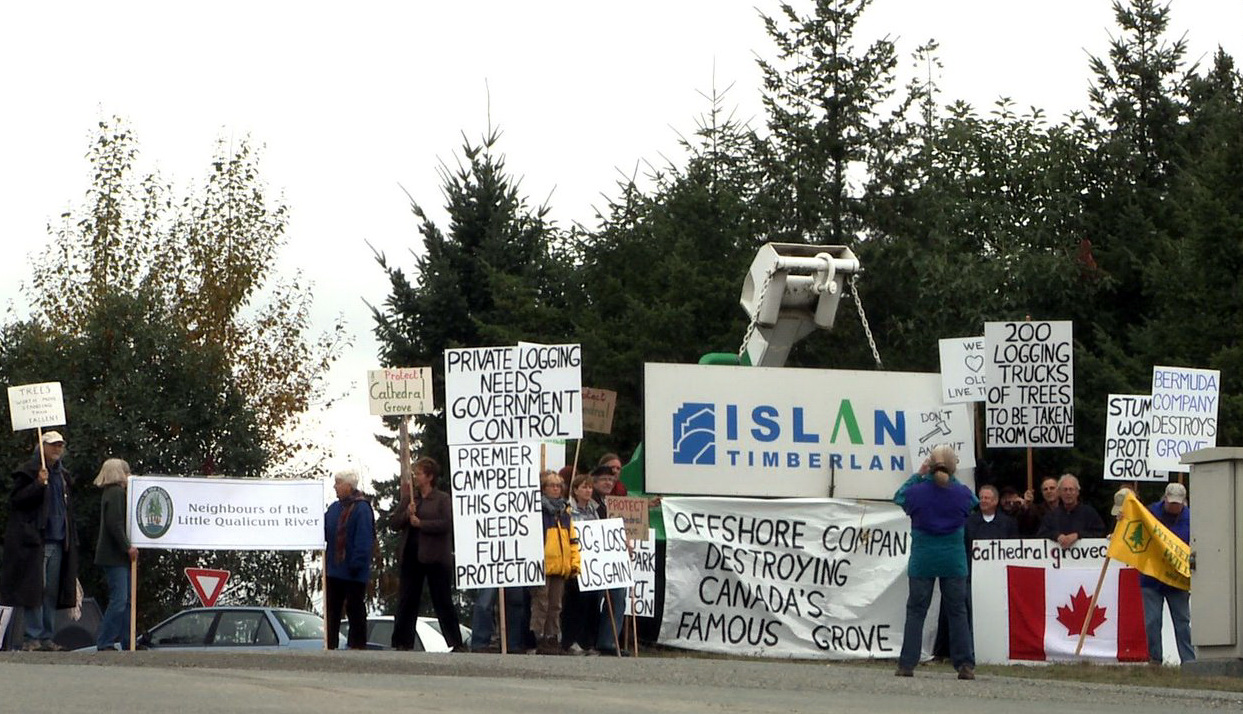
Protest against Island Timberlands, 7 October 2008
Photo: Phil Carson (Click to enlarge) |
|
A press release issued on 3 October 2008 by the Friends of Cathedral Grove (FROG) reported: "Island Timberlands has recently graded a flat acre of land likely to be used as a log dump for helicopter logging operations and is systematically cutting down all old growth forests above the industrial tree plantations on Mount Arrowsmith"
Crime Against Nature. This destructive logging operation in a community watershed was condemned and protests were immediately organized, on 6 October in Cathedral Grove and the next day at the Nanoose office of Island Timberlands (left and below). |
|
| |
|
|
|
|
| |
Island Timberlands Destroys Old Growth Habitat
Community Protest at Cathedral Grove — 7 October 2008 |

|
Unethical Logging by Island Timberlands = Brookfield = NYSE: BAM = TSX: BAM.A = BAMA. EU |
|
|
| |
|
|
|
|
| |
 |
 |
 |
 |
Crime Against Nature
by Island Timberlands
3 October 2008 |
Cutting Down the Last
of the Ancient Forest
5 October 2008
|
Timber Company to Log on
Border of Cathedral Grove
13 October 2008
|
Restoring the Public Good
on Private Forestlands
2008
|
|
|
| |
|
|
|
|
| |
 |
Above: the report by Ben Parfitt examines the logging rates, wood waste levels, log exports and proposed land sales on private forestlands owned by Western Forest Products, TimberWest and Island Timberlands. "Logging rates are, in some cases, twice what auditors say can be sustained and in key cases jumped dramatically after the province allowed companies to pull their private holdings out of tree farm licenses.
Such disturbing trends highlight why BC needs a private Forest Land Reserve which would allow governments to ensure private forestlands are managed in the public interest" Canadian Centre for Policy Alternatives
Left: Photo used to illustrate the report, showing clearcut logging by Island Timberlands near the top of the "Hump" in the Cathedral Grove Watershed, 2007 |
|
|
| |
|
|
|
|
| |

Island Timberlands logging, 2008
Labour Day Lake, Cathedral Grove Watershed
|
|
Labour Day Lake is 24 km southeast of the big tree stand: it is the source of the Cameron River and provides local communities with drinking water. Unethical clearcutting here (left) is further evidence of the destruction caused by Island Timberlands in the Cathedral Grove Watershed.
As the last primaeval forest stands are being massacred by greedy logging corps operating on private lands with no environmental regulations, local communities are increasingly registering their outrage. Fed up with the corporate greenwash, on 16 April 2008 the Association of Vancouver Island Coastal Communities demanded an immediate "moratorium on the sale and land transfer of all land currently zoned as Forest or Resource Land and a moratorium on development approvals within those forest land"
Moratorium. |
|
| |
|
|
|
|
| |

Protest rally in Victoria, 11 October 2008
Photo: Wilderness Committee
This member based environmental organization has formulated an admirable programme to "enact legislated timelines to quickly end old growth logging on Vancouver Island and the Lower Mainland (ie. the south coast) where old growth forests are now scarce." It insists on these steps: "Ensure the sustainable logging of second growth forests which now constitute 75% of the productive forests on BC's south coast. Ban the export of raw, unprocessed logs to foreign countries in order to ensure a steady supply of logs for BC's saw mills and pulp mills. Assist in the retooling and development of second-growth mills and value - added wood processing facilities." |
|
On 25 October 2008 the Western Canada Wilderness Committee held yet another "Rally for Ancient Forests" in Victoria, once again demanding an immediate halt to the logging of Vancouver Island's old growth forests (left and below).

Protest, Victoria, 11 October 2008
Photo: Wilderness Committee |
|
| |
|
|
|
|
| |

Douglas firs, Cathedral Grove
Photo: Klaus Rademaker
|
|
An ancient Douglas fir is a biological colossus with a massive deeply furrowed trunk that ascends like an arrow straight upwards (right). In the oldest specimens, branches occur from upwards of hundred meters on the stem. The green canopy about which little is scientifically known can reach an unbelievable height of over 400 feet (122 m).
A visitor's reactionwas described as follows: "I once brought a visiting British forester to Cathedral Grove. After walking the trails and describing some of the forest’s features to him we stopped near one of the larger Douglas – firs. I noticed that tears were flowing down the man’s face. I thought he was in some physical pain, so I asked what I could do to help. His somewhat choked reply was that I had provided him with the most extraordinary experience of his long forestry career. He was overwhelmed by the amazing size and beauty of the Grove.
Kerry Joy (BC Forest History Association, 2004) |
|
| |
|
|
|
|
| |

Protest banner, Cathedral Grove, 2004
Photo: Ingmar Lee
To prevent the government from cutting down more of the already degraded forest habitat at Cathedral Grove for a parking lot and exposing the Douglas fir giants to further blowdown, the Friends of Cathedral Grove staged a two year blockade, ending in 2005 (above). During these times of climate change, when old growth preservation is vital, the commercial killing of big trees is barbaric. |
|

Douglas firs, Cathedral Grove
Photo: Alanna |
|
| |
|
|
|
|
| |

Click image above to view the Gallery |
|
|
Old Growth Forests Environmental activist and Wilderness Committe campaigner Ken Wu was interviewed by the geographer and environmental writer Briony Penn for an article on old growth forests published in 2007 (left). Both present a compelling argument for protecting the rapidly vanishing ancient forests of BC and concludes that only by urgent political intervention is it possible to stop the industrial extermination of the big trees. Already over 75 per cent of the original, productive old growth forests on Vancouver Island have been logged, including 90 per cent of the valley bottoms where the largest trees grow. |
|
| |
|
|
|
|
| |

Endangered Douglas fir ancient temperate rainforest, Cathedral Grove, Vancouver Island, Briitish Columbia
Photo: Bruce and Angie Bernard |
|
| |
|
|
|
|
| |
|
|
| |
©
Credits & Contact |
|
| |
|
|
|
|