| |
|
|
|
|
| |
The Protest |
|
|
|
| |
|
|
|
|
| |
Big Trees Destroyed |
|
The Treesit |
|
| |
The Parking Lot |
|
FROG "Ribbits" |
|
| |
Friends of Cathedral Grove (FROG) |
|
Cathedral Canyon |
|
| |
|
|
|
|
| |
|
|
| |
|
|
|
|
| |
Friends of Cathedral Grove
The Friends of Cathedral Grove (FROG) is a loosely organized citizens group dedicated to the protection and conservation of the rare and endangered ancient Douglas fir habitat and its big trees on Vancouver Island in British Columbia (BC). FROG was formed in 2004 when, for the second time within a few years, big trees were slated to be destroyed by the BC government to clear the land for a parking lot. FROG rejects this plan because 1) it involves the killing of big trees on the windward side of Cathedral Grove; 2) it requires the expansion of the already too large highway that bisects the big tree habitat; and 3) it has not gone through a proper public process. FROG demands that the yet greater threat to the big trees be addressed: the continued commercial logging of the Cathedral Grove Watershed. |
|

Dwarfed by big trees, Cathedral Grove
Photo: Richard Boyce |
|
| |
|
|
 |
|
| |

Tree cutting crew stopped by Phil Carson (right).
Photo: Richard Boyce
Phil Carson later explained why he refused to be cowered: "Our action to stop the murder of a Cathedral is about protecting a majestic and spiritually inspiring work of nature. It is also about protecting democracy. It is about confronting short sighted mindless economics. It is about providing a future for our children. I hope Cathedral Grove becomes an international rallying point for resistance to governments that seem to care more about the stock portfolios of foreign investors than the interest of their citizens." |
|
On 9 February 2004 with no prior public consultation a logging crew contracted by the BC government appeared in Cathedral Grove to clear about five acres of floodplain forest for a parking lot. FROG member Phil Carson (in jeans) is seen confronting the crew (left), using his body to protect a large Douglas fir tree
– marked with a pink ribbon – to prevent its destruction, while the crew (in orange hard hats) discuss the situation. A menacing grappler stands in the background.

Direct action by FROG to save big tree.
Photo: Richard Boyce |
|
| |
|
|
|
|
| |
|
Logging Crew Contracted by BC Government
Stopped by FROG – 9 February 2004 |
 |
 |
Activist (left) confronts logging crew |
Activists (right) defend marked tree |
 |
 |
Government supervisor of logging crew |
News media arrives to investigate |
 |
 |
Logger returns to truck with his chainsaw |
Fallerbuncher departs from Cathedral Grove |
|
|
| |
|
|
|
|
| |

"Stand at Cathedral Grove." (Click to enlarge)
A Chroncle by Richard Boyce |
|
The confrontation between FROG and the logging crew contracted by the government was videorecorded by filmmaker and FROG member Richard Boyce (above). He also wrote a chronicle of the events in February and March 2004 (left) which included several court dates to defend the public right to protest:
Stand at Cathedral Grove. Blame for the debacle of government ineptitude lies squarely on the inappropriately named BC Ministry of Water, Land and Air Protection. |
|
| |
|
|
|
|
| |
"Everyone recognises the absolute travesty of what is going on in our forests, what is happening to our water, our wildlife, our fish, our economic, cultural, and spiritual integrity . . . If we can't protect Cathedral Grove we might as well turn the whole of Vancouver Island over to the chainsaws of the industrial foresters and the bulldozers of the real estate developers. Those who belittle the contribution of people who put themselves between the fallerbunchers and the trees I would remind that without those determined souls, the parking lot would already be paved and the remainder of the giant trees outside
the boundaries of the tiny park already clearcut" Phil Carson (FROG).

Tree marked for destruction, Cathedral Grove, 2004.
Photo: Scott Tanner |
|

Self-portrait with grappler, 2004.
Photo: Richard Boyce
Standing next to an old growth Douglas fir marked for destruction is Annette Tanner, chairperson of the Mid Island Western Canada Wilderness Committee (left). The widespread protest against the mismanagement of Cathedral Grove, forced the government to apply for a court injunction to use police force to arrest members of the public for trespassing on Crown land. Known as a SLAPP (Strategic Lawsuit Against Public Participation), this was the same quasi legal tactic used by MacMillan Bloedel and the government in 1993 to have 871 civilians arrested for protesting against the clearcut logging of Clayoquot Sound. |
|
| |
|
|
|
|
| |

Logged cedar stump, Cathedral Grove.
Photo: Flickr |
|
In a landmark ruling on 28 May 2004, Justice G. M. Quijano of the BC Supreme Court rejected the government's application for a SLAPP to facilitate the arrest of protestors at Cathedral Grove. She stated: "An injunction is a powerful remedy which may transform a dispute between a citizen and the government into a dispute between the citizen and the court and it is not to be used as a first choice remedy except in extraordinary circumstances"
BC v. Sager et al.
FROG activists insist that no more logging take place in the 136 hectare park which represents less than one percent of the remaining ancient Douglas fir ecosystem on Vancouver Island. The vunerable big tree stand has already been degraded by commercial logging – borne witness by giant stumps with springboard gouges (left). Maureen Rose Sager, one of the Cathedral Grove defendants had already registered her rejection of the government parking lot scheme in 2001: "The proposed location is on the Cameron River floodplain within a designated Community Watershed. The existing forest provides critical habitat for a small and threatened elk herd as well as habitat for three red-listed plant species. The trees growing there now provide a windthrow buffer for the ancient trees in the Park. This buffer is needed as evidenced by the damage done to the Park by the wind storm of 1 January 1997"
Alberni Environmental Coalition. |
|
| |
|
|
|
|
| |
SLAPPs are commonly brought by corporations, developers and governments against individuals, community groups and First Nations in response to the latter's concern over the mismanagement of public land. SLAPPs make mockery of the government's claim to engage in open and publicly accountable longterm stewardship of the natural resources. Big trees are part of our common natural heritage as well as of First Nations heritage. Virtually all cedar trees located in the Cathedral Grove Watershed are "culturally modified trees." Yet a forest remnant adjacent to Cathedral Grove, where such trees are prevalent, has been classified as "commercial" and "private" land (right and below).

Culturally modified tree, Cathedral Grove, 2006.
Photo: Karen Wonders
FROG respectfully acknowledges First Nations as the historic and rightful stewards of the Cathedral Grove Watershed and supports a comprehensive archaeological survey of the entire area to locate and protect the culturally modified trees, traditional trails and places of spiritual significance. Longterm conservation plans for Cathedral Grove must take into account sustainable economic ventures for First Nations as well as local communities and municipalities, tourism associations, outdoor groups, natural history societies and fish and game organizations. The venerable big trees could thus serve as ambassadors of nature (right) who welcome visitors to the the West Coast of Vancouver Island. |
|

Burned cmt next to Cathedral Grove.
Photo: Richard Boyce
Any decisions on land use in BC are required to be made in consultation with First Nations. Yet in 2004 Weyerhaeuser and the BC government deliberately misled Hupacasath First Nation over the privatizing of 70,000 hectares of one third of its traditional territory. Chief Councillor Judith was forced to sue. She reported: "To date, Hupacasath have not been consulted on any proposed trails and only participated in the archaeological survey of the proposed parking lot in Cathedral Grove. Consultation has yet to occur."

Ancient cedar, Cathedral Grove, 2006.
Photo: Hexe |
|
| |
|
|
|
|
| |

Big tree with hollow, Cathedral Grove.
Photo: Dennis Internet Gallery
Today the vital importance of preserving old growth forest remnants as carbon sinks is well understood both scientifically and by the general public. Cathedral Grove is regularly used as a model to illustrate what is being lost by clearcutting. An example is a poster for an eco play (right). A widely cited article in Science Magazine (23 January 2009) concludes that big trees in BC are dying at an accelerated rate due to climate change. A photo of Cathedral Grove was used to illustrate a newspaper article in the Vancouver Sun on the report:
Trees are dying (22 January 2009). |
|

"Old Growth," 2008.
Poster by Carl Chaplin |
|
| |
|
|
|
|
| |

Steffie with big tree icon, Cathedral Grove, 2008
Photo: Bruce & Angie Barnard |
|
| |
|
|
|
|
| |

Big tree, Cathedral Grove, 21 September 2007.
Photo: Flickr
In response to the surprise assault on the park in 2004, the Friends of Cathedral Grove (FROG) prepared a list of recommendations to the BC government that included: a new park masterplan with a broad watershed focus; a world heritage designation with co management by First Nations; the rerouting of commercial traffic; the use of shuttle buses for visitors; and basic safety measures such as stop signs, crossguards, lower speed limits and speed control bumps. |
|
European visitors to Cathedral Grove are amazed by the size and age of the giant trees: "Stellen Sie sich vor," advises one German tour operator, "wie die Westkueste ausgesehen haben muß, bevor die ersten europischen Siedler kamen" (Here you can imagine how the West Coast appeared in its primaeval state before European settlement). That these trees are the keystones of wilderness ecosystems, unlike the planted single specimens in Europe, makes them especially remarkable.

Park visitors, Cathedral Grove.
Photo: Flickr |
|
| |
|
|
|
|
| |

Park visitor, Cathedral Grove, 2008.
Photo: Demeanour
FROG is calling on BC to change legislation so that primaeval forest trees cannot be logged. Furthermore FROG takes the position that corporations which continue to log in the Cathedral Grove Watershed should be boycotted. Issues that the government must address are an urgent ban on logging in Cathedral Canyon, the protection of First Nations heritage, the preservation of fish and wildlife habitat, and the limiting of highway expansion and visitor impact. |
|

Big tree, Cathedral Grove, 2006.
Photo: Flewid |
|
| |
|
|
|
|
| |

Douglas fir ecosystem, Cathedral Grove.
Photo: E. Wolff |
|
Primaeval forest remnants and big trees in BC are not only affected by climate change, they are also being increasingly isolated and encroached on by logging, development and pollution. It is easy for the government to bat around words such as "sustainability, accountability and responsibility" but without protective legislation, such words are nothing more than a hollow form of greenwash that conceals the appalling sell out to industry.

School group, Cathedral Grove.
Photo: anon
Such was the scale of commercial greed over the past half century on Vancouver Island that today there is less than one percent remaining of the coastal Douglas Fir ecosystem (left) and valley bottom old growth stands represented by Cathedral Grove. Weyerhaeuser's brutal clearcut logging of the buffer zone around the Grove in 1999 – 2000 was an ecological crime that is being repeated in 2009 by Island Timberland's clandestine heli logging of Cathedral Canyon. |
|
| |
|
|
|
|
| |
Non Human Friends of Cathedral Grove |
 |
 |
Pileated Woodpecker by Richard Boyce |
Red Squirrel by Richard Boyce |
 |
 |
Flicker Hen and Chicks by Richard Boyce |
American Pine Martin by Richard Boyce |
 |
 |
Red–legged Frog by Richard Boyce |
Spotted Slug by Richard Pitt |
 |
 |
Two Roosevelt Elk by Richard Boyce |
Salamander by Richard Boyce |
|
|
| |
|
|
|
|
| |

Visitor pathway, Cathedral Grove, 2008.
Photo: Flickr |
|
Many non human "Friends of Cathedral Grove" inhabit the ancient
Douglas fir forest (above). For these vunerable creatures – some endangered species – Cathedral Grove is their "Lebensraum," their living space. The ruination of their habitat by logging diminishes their ability to survive and reproduce, but they cannot protest. A Flicker hen, for example, feeds her three nesting chicks in a habitat tree located in the area planned to be paved over for a parking lot (above left). BC has no effective endangered species legislation that might interfer with its resource extraction economy. Thus even a unique and world class nature treasure such as Cathedral Grove is at risk. The hundreds of thousands of yearly visitors who come to be uplifted and replenished by the spectacular big trees (left and below) have no idea of how close the forces of destruction lurk.

Visitors, Cathedral Grove, 2008.
Photo: Flickr |
|
| |
|
|
|
|
| |
Plant Inhabitants of Cathedral Grove |
 |
 |
Brain of the Woods by Richard Boyce |
Orange Tree Fungi by Alanna |
 |
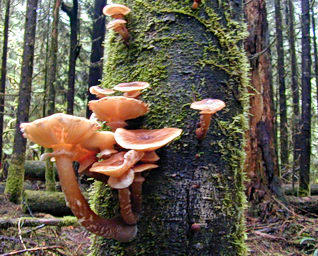 |
White Trillium by Robert Berdan |
Colony of Tree Fungi by anon |
 |
 |
Huge Devil's Club Leaves by anon |
Purple Chocolate Lily by Poecile |
 |
 |
Single Mushroom in Moss by Tod |
Delicate Mushrooms by anon |
 |
 |
Temperate Rainforest Ferns by Whipstar |
Old Man's Beard by Gdraskoy |
|
|
| |
|
|
|
|
| |

Salmon in habitat similar to Cathedral Grove.
Photo: Ian McAllister
According to David Clough, a biologist with 25 years of experience in restoring stream habitat, Cathedral Grove is in part a floodplain of fish habitat. In a scientific report of field data he researched, he advises: "It is highly sensitive to alteration through roads, logging or trails. It should not be further developed and needs restoration of existing works if it is to continue to support fish habitat within the ecosystem that they require"
Fish Habitat Assessment. |
|

Cameron River floodplain.
Cathedral Grove, Vancouver Island |
|
| |
|
|
|
|
| |

Fallen giant, Western red cedar (Thuja plicata), Cathedral Grove, September 24, 2008.
Photo: DCI |
|
| |
|
|
|
|
| |
|
|
| |
©
Contact & Credits |
|
| |
|
|
|
|
